Which Is the Best Lava Cave in Iceland?
There is no single best lava cave in Iceland, but there is a clear answer for each reason you might be going. Raufarhólshellir wins on distance underground and on proximity to Reykjavík. Víðgelmir wins on sheer volume. Vatnshellir wins on age, at about 8,000 years, and on being the only one inside a national park. Lofthellir is the only one with ice on the floor, and Þríhnúkagígur, which everyone lumps in, is not a lava cave at all. Below is all five side by side with real prices and drive times as of July 2026. If you have already settled on Snæfellsnes, the tour there has the current times.
Quick answer
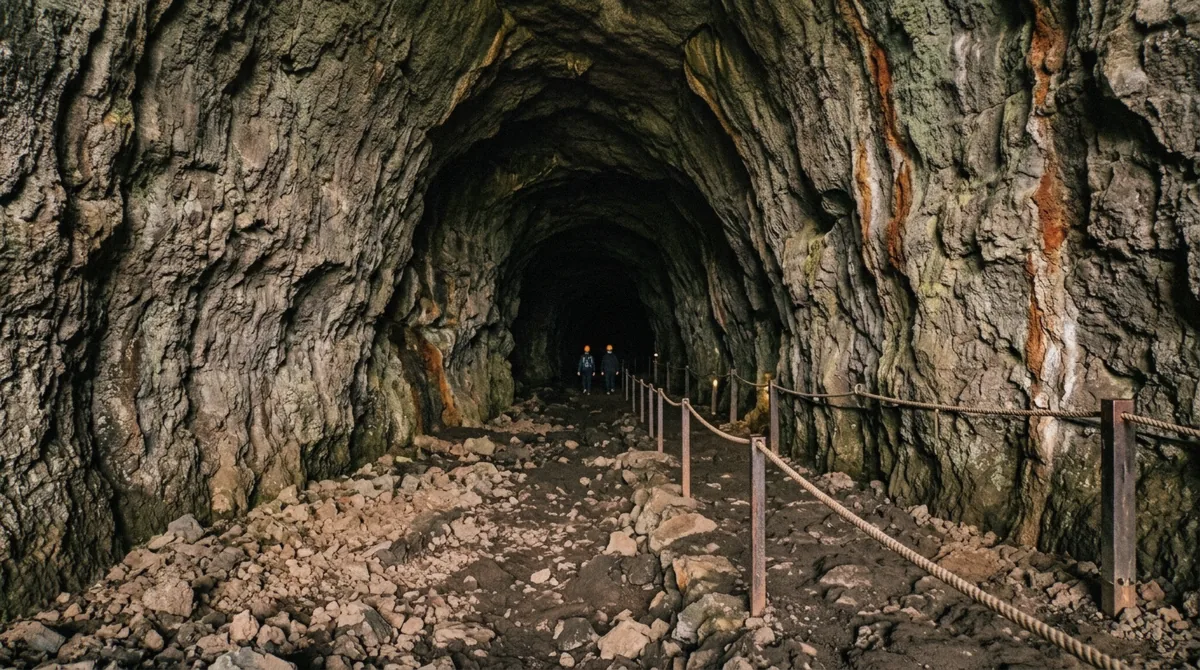
For most visitors the answer is Raufarhólshellir, because it is 30 minutes from Reykjavík and gives you 1,360 metres of tube on a lit footbridge. Choose Víðgelmir for the largest volume, Vatnshellir for the oldest cave and the only one in a national park, Lofthellir for natural ice, and Þríhnúkagígur if you want to be lowered into a magma chamber instead.
Key takeaways
- Raufarhólshellir: 1,360 m, about 5,200 years old, 35 km from Reykjavík, lit walkway
- Víðgelmir: 1,585 m and about 148,000 m³, formed around 900 AD, walkways and lighting
- Vatnshellir: 200 m, 35 m deep, about 8,000 years old, two spiral staircases, from $46
- Lofthellir: natural ice formations, super-jeep access, four hours, listed at $391
- Þríhnúkagígur: not a lava tube but a drained magma chamber, lift down about 120 m, May to October only
- Minimum ages differ: 5 at Vatnshellir, 3 at Raufarhólshellir, 12 for its Lava Falls route
The Short Answer
Pick by reason, not by ranking
Every list that names a single winner here is dodging the question, because the five caves differ on axes that do not trade off against each other. A 200-metre tube that is 8,000 years old and a 1,585-metre tube that is 1,100 years old are not better and worse versions of the same thing.
So: if you have one day and a rental car in Reykjavík, go to Raufarhólshellir. If you want the biggest space underground, go to Víðgelmir. If you are already driving Snæfellsnes, Vatnshellir is on your route and the others are not. If you want ice, only Lofthellir has it. And if what you actually want is to stand inside a volcano, Þríhnúkagígur is a different product that costs several times more and only runs half the year.
Iceland's Visitable Volcanic Caves Side by Side
All five, on the numbers
Prices and ratings were checked on 29 July 2026. Everything is guided; none of these can be entered alone.
| Cave | Age | Length | How you get in | Tour length | From | Drive from Reykjavík | Season |
|---|---|---|---|---|---|---|---|
| Raufarhólshellir | About 5,200 years | 1,360 m | Walk in, lit footbridge | About 1 hour | $70 | 30 min, 35 km | Year-round |
| Víðgelmir | Around 900 AD | 1,585 m, 148,000 m³ | Stairs into a collapsed section, then walkways | 1.5 hours | Operator direct | About 1.5 hours | Year-round |
| Vatnshellir | About 8,000 years | 200 m, 35 m deep | Two spiral staircases | 45 minutes | $46 | 2 hours, 136 km | Year-round |
| Lofthellir | Volcanic, ice-floored | Not published | Super-jeep, then a scramble | 4 hours | $391 | Flight to Akureyri | Seasonal |
| Þríhnúkagígur | About 4,000 years | Not a tube | Lowered about 120 m by open lift | Half a day | Operator direct | About 30 min plus a hike | May to October |
Reading the table
Two things stand out. The first is that Vatnshellir is by far the shortest walk and by far the oldest cave, which is the trade this whole comparison comes down to. The second is that Þríhnúkagígur does not belong in a length column at all, because it has no passage: you are lowered into a void.
On the booking platform, Raufarhólshellir's own underground expedition holds 4.7 from 1,944 reviews and Vatnshellir holds 4.7 from 261. Identical scores, wildly different sample sizes, and the smaller number reflects how far off the Reykjavík day-trip circuit Snæfellsnes sits rather than anything about the tour.
Vatnshellir, Snæfellsnes
The oldest, and the shortest
About 8,000 years old, 200 metres long, 35 metres deep, entered by two spiral staircases. Forty-five minutes, from $46, helmet and torch included, and the only cave on this list inside a national park.
The age is not trivia. Eight thousand years of water working through basalt is why the walls carry rust-red iron, pale yellow sulphur and green copper, and why a cave this small is worth the descent. It has had roughly seven thousand years longer than Víðgelmir to accumulate that.
Being inside Snæfellsjökull National Park matters in a practical way too: the rules about staying on marked paths are enforced rather than suggested, and access has been guided-only from the start, which is why the fragile detail that survives has survived.
- Best for: anyone already driving the Snæfellsnes peninsula
- Worst for: anyone who wants distance underground
- Minimum age 5; children 5 to 11 free at the gate
- The two spiral staircases are the real fitness gate, not the depth
The honest downside
It is 136 km from Reykjavík for 45 minutes underground. Nobody should make this drive for the cave alone, and the recurring criticism in recent reviews is from people who expected something larger. As one stop on a peninsula day it is excellent value; as a destination it is a long way for 200 metres. What is actually down there sets expectations properly.
Raufarhólshellir, Near Reykjavík
The one most people should pick
Iceland's fourth-longest lava tube at 1,360 metres, formed by the Leitahraun eruption about 5,200 years ago, and 35 km southeast of Reykjavík on a paved road, which works out to a 30-minute drive. The standard tour walks a built, lit footbridge through the front section for about an hour, from $70.
It is the practical winner for most itineraries. You can do it on a morning, you do not need to commit a day to it, and the walkway makes it far easier underfoot than Vatnshellir. There is a longer Lava Falls route to the far end, three to four hours on head torches, minimum age 12.
- Best for: one free morning in Reykjavík, or anyone who wants distance
- Worst for: anyone hoping for an unmodified cave
- Minimum age 3 when you meet at the cave
- Three columns of daylight fall through collapsed skylights near the entrance
Why it has a walkway
Because it was wrecked. More than 20,000 people a year walked in unsupervised, and by the time it closed in late 2016 nearly all its fragile lava straws had been snapped off. Several tonnes of rubbish came out. It reopened in 2017 with elevated walkways, lighting and guided access only.
That history is the clearest argument for the locked hatch at Vatnshellir, and it is worth knowing before you compare the two on atmosphere. One of them has infrastructure because it needed saving.
Víðgelmir, Hallmundarhraun
The largest by volume
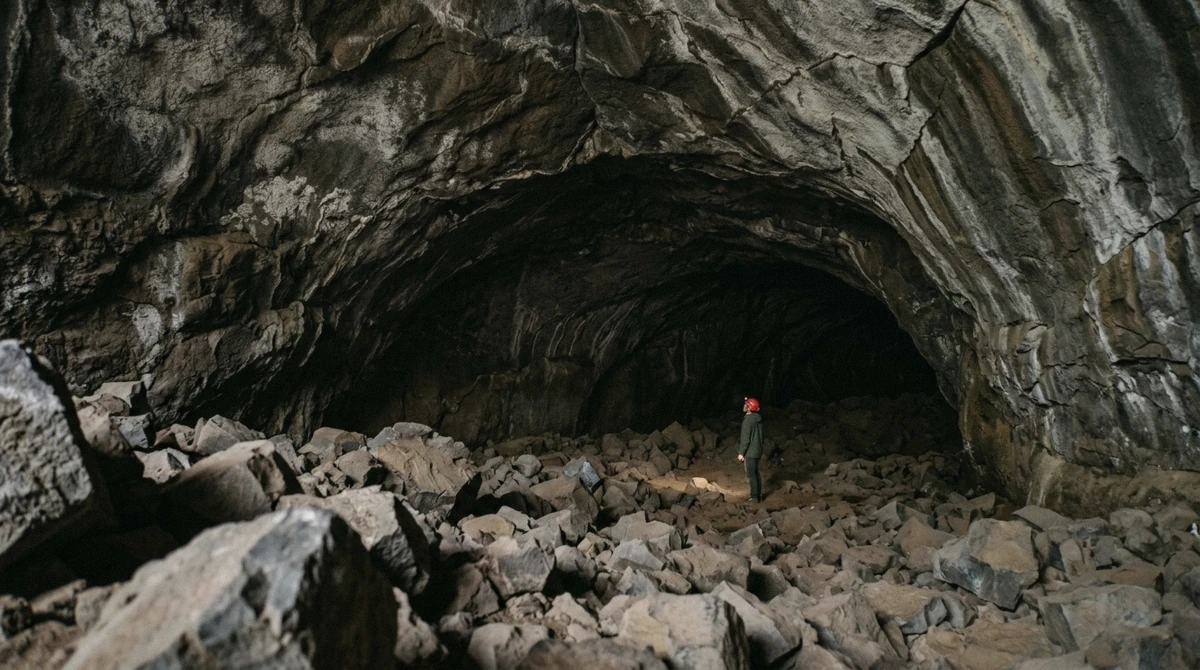
About 1,585 metres long and roughly 148,000 cubic metres, which makes it Iceland's largest lava cave by volume. It formed in the Hallmundarhraun eruption around 900 AD, making it the youngest cave on this list by several thousand years, and the operator calls it the king of Icelandic caves without much argument from anyone.
It has built walkways and lighting, and the standard Cave Explorer tour runs about an hour and a half. Seasonal ice forms inside. The drive from Reykjavík is about an hour and a half, into the interior rather than along the coast, which puts it in a different day from either of the other two.
- Best for: scale, and for combining with Húsafell or the Silver Circle
- Worst for: anyone chasing an old cave; at 1,100 years it is the youngest here
- Walkways and lighting throughout, so easy underfoot
- Coloured vaults are its signature, like Vatnshellir's but on a larger canvas
Þríhnúkagígur: Not a Lava Cave at All
The distinction that matters
Þríhnúkagígur appears on every list of Iceland's caves and it does not belong on any of them. A lava tube is a drained channel: lava ran downhill, the surface crusted over, the melt drained away, and the roofed channel stayed. Þríhnúkagígur is a drained magma chamber, which is the reservoir the lava came out of rather than the pipe it ran through.
That is why you cannot walk in. Visitors are lowered about 120 metres in an open lift through a hole in the top, into a space the size of a cathedral. It runs roughly May to October, because the approach hike is not viable in winter, and it costs several times more than any tube on this list.
If you have the budget and you are in Iceland in summer, it is the most extraordinary thing on this page. It is also the only one with a closed season, and it is not what you are searching for when you type lava cave.
- Best for: scale and a genuine one-off, in summer, with budget
- Worst for: winter trips, tight budgets, and anyone who wanted a tube
- The only cave here that is not open year-round
- The operator does not publish a headline adult price on its front page
Lofthellir and the Ice-Floored Outlier
North Iceland, and expensive
Lofthellir sits near Mývatn in the north. It is a volcanic cave with natural ice formations on the floor, and it needs a super-jeep to reach followed by a scramble to get inside. The tour runs four hours and lists at $391, which is more than five times the Snæfellsnes cave and nearly six times what you pay at Raufarhólshellir.
It is also the only cave on this list with ice, which matters if that is what you pictured. Vatnshellir is dry rock, Raufarhólshellir gets ice sculptures near its entrance in deep winter, and Víðgelmir gets seasonal ice, but none of them is an ice cave.
The practical problem is location. Lofthellir only makes sense if you are already flying to Akureyri or driving the full ring road.
- Best for: ice formations, if you are in north Iceland anyway
- Worst for: budget, and anyone based in Reykjavík
- Super-jeep access, four hours, small groups
- Rated 5.0 from 15 reviews, a very small sample
What a Guided Cave Actually Costs You
Money, and the hour you do not get back
The ticket is rarely the real cost. Vatnshellir is $46 and 45 minutes, but it is 136 km from Reykjavík, so the true price is most of a day. Raufarhólshellir is $70 and about an hour, half an hour from the city, so the true price is a morning. That inversion catches people out: the cheaper ticket is the more expensive day.
Víðgelmir sells through the operator rather than the platforms, at about an hour and a half in the cave and an hour and a half of driving each way into the interior. Lofthellir's $391 buys four hours including super-jeep transport, and it only makes sense if you are already in the north. Þríhnúkagígur is a half-day product and does not publish a headline price on its front page, which tells you roughly where it sits.
| Cave | Ticket | Time in the cave | Round-trip driving from Reykjavík | Real cost of the day |
|---|---|---|---|---|
| Raufarhólshellir | From $70 | About 1 hour | About 1 hour | A morning |
| Þríhnúkagígur | Operator direct, premium | Half a day | About 1 hour plus a hike | A full day, summer only |
| Víðgelmir | Operator direct | 1.5 hours | About 3 hours | Most of a day |
| Vatnshellir | From $46 | 45 minutes | About 4 hours | A full day, best shared with the coast |
| Lofthellir | From $391 | Part of 4 hours | Not viable; fly to Akureyri | A north Iceland trip |
Which is why nobody should drive to Vatnshellir for the cave alone
Four hours of driving for 45 minutes underground is a bad trade on its own terms. It becomes a good one the moment you put Lóndrangar, Djúpalónssandur and Arnarstapi around it, all of which are free and within 25 minutes of the same car park. That is the honest framing, and it is why this cave rewards a Snæfellsnes day rather than a cave-hunting day.
What None of Them Are
There is no flowing lava
This needs saying because the search volume for seeing lava in Iceland is enormous and the honest answer is disappointing. None of these caves contains molten rock, and none is warm. Vatnshellir sits at 4 to 6°C; Raufarhólshellir at 3 to 4°C.
The last eruption you could walk to was at Fagradalsfjall on the Reykjanes peninsula, and it has been quiet since August 2023. When Iceland erupts again the site will most likely be closed to visitors while it is active, and it will not be a cave. If you want to see lava move, the honest substitute is the Lava Show in Reykjavík or Vík, where molten rock is poured in front of an audience.
- No flowing lava in any Icelandic cave, and none expected
- No warmth: every cave here sits within a few degrees of freezing
- No cathedral-sized halls except Þríhnúkagígur, which is not a tube
- No unguided access to any of them
Which One Fits Your Trip
If you have one free day based in Reykjavík
Raufarhólshellir. Thirty minutes each way, 1,360 metres underground, back in the city for lunch.
If you are driving the Snæfellsnes peninsula
Vatnshellir. It is on your road, it is the oldest cave in the country you can enter, and 45 minutes is all it asks.
If you want the biggest space underground
Víðgelmir, at 1,585 metres and about 148,000 cubic metres, with walkways the whole way.
If you want ice on the floor
Lofthellir, and only if you are already in north Iceland. At $391 it is not a detour purchase.
If you are in Iceland in summer with budget to spend
Þríhnúkagígur. Not a lava cave, and the most memorable of the five.
If you cannot manage stairs
Víðgelmir or Raufarhólshellir for their walkways. Vatnshellir's two spiral staircases are the barrier.
Iceland's Lava Caves: Common Questions
Which is the best lava cave in Iceland?
Raufarhólshellir for most visitors, because it combines 1,360 metres of tube with a 30-minute drive from Reykjavík. Vatnshellir is the oldest at about 8,000 years and the only one inside a national park, Víðgelmir is the largest by volume, and Lofthellir is the only one with natural ice.
Is the lava tunnel in Iceland worth it?
Yes, if you understand what a lava tube is: a drained channel, dry and cold, with the shape of an ancient lava river rather than anything molten. People who go expecting warmth or flowing rock come away disappointed, and that is an expectations problem rather than a fault in any of these caves.
Where can I see flowing lava in Iceland?
Nowhere at the moment. The last eruption accessible on foot was at Fagradalsfjall, quiet since August 2023. The nearest thing is the Lava Show in Reykjavík or Vík, which melts and pours real basalt in front of an audience.
What is the difference between a lava tube and Þríhnúkagígur?
A lava tube is the pipe the lava ran through; Þríhnúkagígur is the chamber it came out of. That is why you walk into one and get lowered about 120 metres into the other, and why Þríhnúkagígur only operates from roughly May to October.
Which cave is closest to Reykjavík?
Raufarhólshellir, 35 km southeast, a 30-minute drive on a paved road that is open year-round. Vatnshellir is 136 km away, about two hours.
Which is best for young children?
Raufarhólshellir takes children from 3 when you meet at the cave, and its lit footbridge is far easier than bare rock. Vatnshellir starts at 5 and requires two spiral staircases walked unaided; what that means in practice is worth reading first.
Can I visit any of them without a guide?
No. All five are guided-only. Raufarhólshellir went that way in 2017 after unsupervised visitors had stripped it, and Vatnshellir has been guided-only since it opened to the public.
Is Vatnshellir better than Raufarhólshellir?
Older and more colourful, but a fifth of the length and two hours further from Reykjavík. If you are on Snæfellsnes, Vatnshellir; if you are in Reykjavík with a free morning, Raufarhólshellir. Neither answer changes on quality.
Five caves, and the only wrong choice is the one made on a ranking rather than a map. Age, length and access pull in different directions here, and the cave that suits a Reykjavík morning is not the one that suits a Snæfellsnes drive. Work out which road you are on, and the answer picks itself.